
When Does Concrete Spalling Need Structural Repair?
When does concrete spalling need structural repair? It's a question most property owners only ask after they've already seen concrete breaking away from a balcony edge or car park soffit, and assumed a patch would fix it. Sometimes that's true. Often it isn't. Concrete spalling exists on a spectrum from surface-level cosmetic deterioration to active structural failure, and the difference between those two outcomes isn't always visible from street level. The gap between a cosmetic repair and a structural repair isn't just technical; it has real consequences for safety, cost, and compliance.
Getting that distinction wrong costs property owners significantly. Under-specifying a repair leaves active corrosion running beneath a fresh patch. Over-specifying sends budgets into full-depth replacement when a targeted repair would have been adequate. At Quin Projects, this kind of assessment is central to our remedial work on Sydney buildings. This guide gives you the framework to understand the difference, and to know when a patch is no longer enough.
How Concrete Spalling Progresses From Cosmetic To Structural Damage
Stage 1: Surface Deterioration Without Rebar Involvement
Early-stage spalling is typically confined to the concrete cover layer. Carbonation advancing through the concrete, environmental weathering, thermal cycling, and surface crazing are the common drivers. At this stage, the reinforcement is untouched and the structural element is performing as designed.
Patching is appropriate when delamination is shallow and the rebar remains fully protected. This is the cosmetic zone, and it's the only category where repair decisions are genuinely straightforward.
Stage 2: Cover Loss And Delamination
It helps to separate two terms that are often used interchangeably. The distinction between delamination and spalling is worth separating clearly: delamination is the horizontal separation of concrete layers beneath the surface, whereas spalling is the physical breaking away of surface material.
Delamination can be extensive before it becomes visible. When it reaches the reinforcement level, the protective alkaline environment around the steel is compromised and the repair decision becomes more complex. A sounding test at this point often reveals hollow sections far larger than the surface damage suggests.
Stage 3: Reinforcement Corrosion And Concrete Cancer
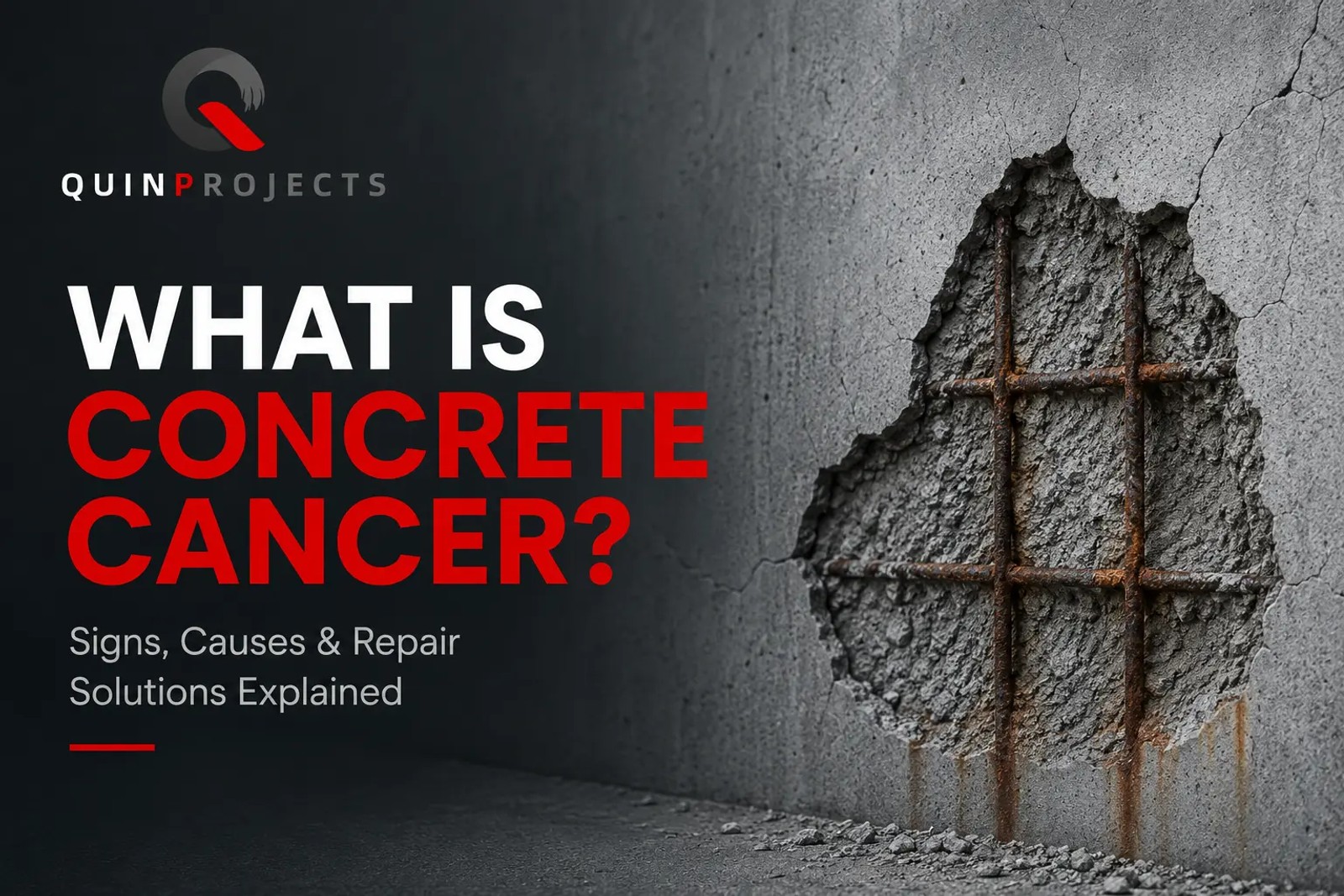
Once moisture and chlorides reach the rebar, active corrosion begins. Corrosion products occupy a greater volume than the original steel, generating internal expansive pressure that accelerates further spalling. This is what the industry calls concrete cancer: a self-reinforcing deterioration cycle where damage spreads faster the further it progresses. At this stage, the question of whether your building needs structural repair stops being theoretical and becomes urgent. The damage is actively growing, and cosmetic concrete cover loss criteria no longer apply.
When Does Concrete Spalling Need Structural Repair? Key Warning Signs
Exposed Rebar And The 50% Circumference Threshold
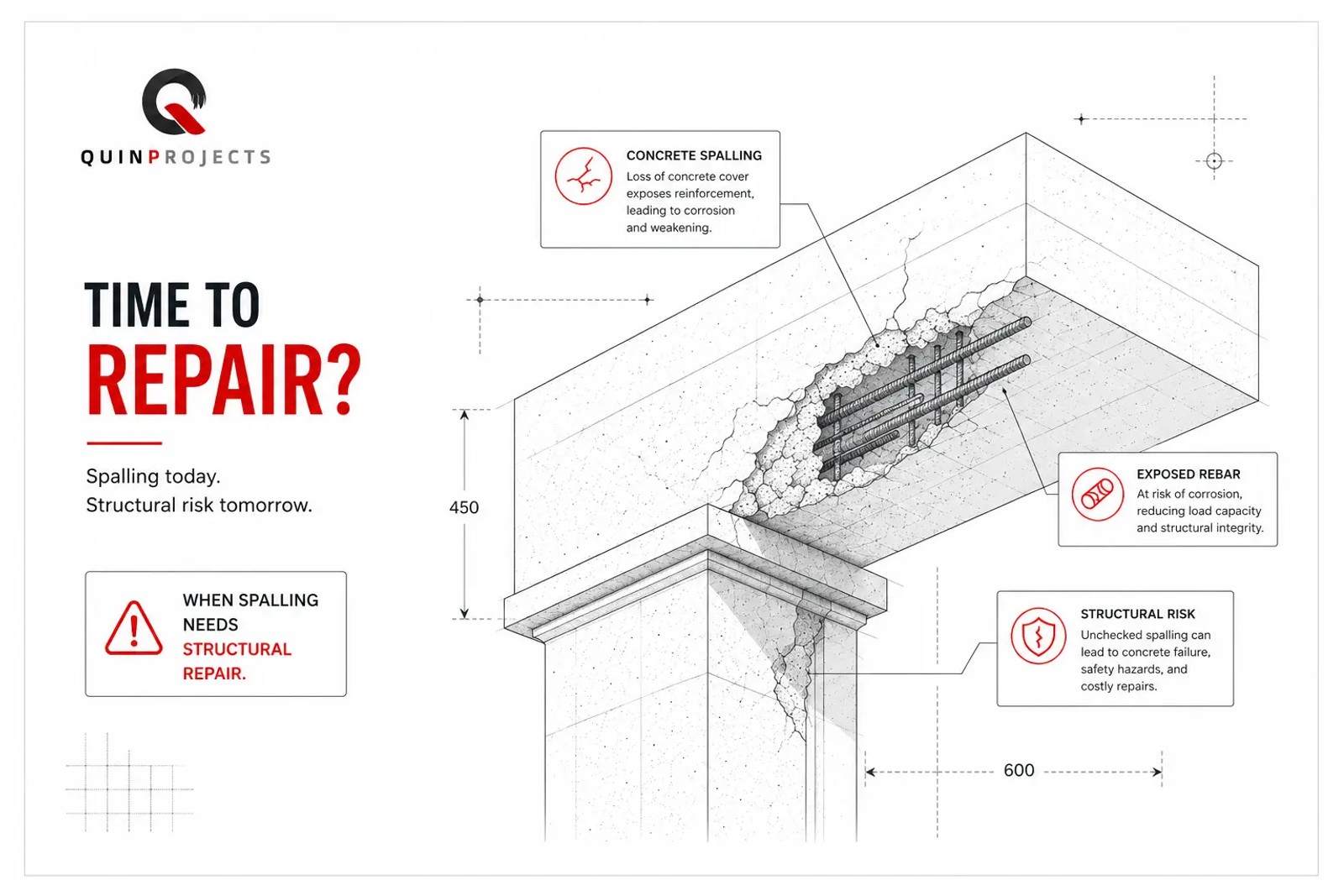
Visible reinforcing steel is not automatically a structural emergency, but it is always a trigger for a structural investigation. The practical threshold used in remedial assessment: if more than 50% of a rebar's outer circumference is exposed, the damage is classified as at minimum an intermediate spall.
If deterioration has extended beyond the outer reinforcement layer, the element is in major spall territory and load-bearing capacity must be evaluated by an engineer. Surface rust staining alone doesn't define the threshold; probe depth and bar exposure area do.
Cracking Patterns And What They Indicate
Longitudinal cracking running parallel to reinforcement is a strong indicator of corrosion-driven expansive pressure below the surface. This is the direct signature of reinforcement corrosion and spalling working together, expanding rust creates internal tensile stress the concrete can't resist.
Map cracking combined with hollow-sounding concrete in a load-bearing soffit, beam, or column face is more serious than isolated surface cracking in a non-structural wall panel. Cracking accompanied by measurable deflection or joint displacement moves into territory that requires engineering review, not just a patching specification.
Section Loss And Deflection In Load-bearing Elements
When concrete loss extends beyond the upper third of a slab's cross-section, or when unsound concrete represents more than half the element's thickness, full-depth repair becomes the standard response.
Visible deflection or sag in beams and slabs is a late-stage sign that structural capacity has already been affected. At this point, structural intervention isn't a preventive measure; it's a safety response. Waiting to see how it develops is not a rational option for an occupied building.
Why Reinforcement Corrosion Changes The Entire Repair Equation
How Steel Cross-section Loss Reduces Structural Capacity
A corroding bar doesn't just look bad; it carries less load. Flexural capacity drops as the effective steel area decreases, and shear capacity can deteriorate even faster because stirrups and transverse reinforcement corrode before the main bars do.
Studies on corrosion-affected columns indicate that 30% steel mass loss can correspond to axial capacity reductions of 38% to 70%, depending on the level of confinement and reinforcement configuration.
Ductility decreases alongside strength, which means less warning before failure and less ability to redistribute forces through the structure.
These aren't laboratory abstractions; they describe the condition found inside corroding balconies, car park soffits, and stairwells in buildings assessed across Sydney and similar coastal environments.
The Halo Effect And Why Patching Alone Fails
Placing fresh repair mortar next to actively corroding concrete creates an electrochemical imbalance. The repaired zone becomes cathodic relative to the surrounding parent concrete, shifting corrosion activity to the adjacent steel in the unrepaired area, causing the edges of the patch to fail prematurely.
This is the halo effect, and it's the reason concrete cancer repair can't be reduced to scraping out the damaged zone and filling it. A repair that doesn't address active corrosion in the surrounding concrete is temporary at best.
Structural-grade repairs include corrosion inhibitors, appropriate concrete cover reinstatement, and in many cases, sacrificial zinc anodes placed around the repair perimeter to protect adjacent steel from becoming the next failure point.
When Does Concrete Spalling Need Structural Repair? Inspection Methods That Confirm the Risk
Sounding And Covermeter Surveys
A systematic sounding survey using a hammer or chain drag identifies delaminated zones that don't appear on the surface. Hollow resonance indicates debonding between concrete layers, pointing to areas where the concrete cover is already compromised.
A covermeter survey then maps the actual depth of cover remaining over the rebar across the element.
Together, these two site methods give the assessor a spatial picture of where concrete cover loss is occurring and how extensive it is, before any concrete is broken out.
Half-cell Potential And Chloride Testing
Half-cell potential testing measures the electrical potential at the rebar, which indicates the probability of active corrosion. Using the ASTM C876 thresholds, readings more negative than -350 mV vs. Cu/CuSO₄ indicate greater than 90% probability of active reinforcement corrosion, which moves the assessment firmly toward structural intervention.
Chloride testing on core samples identifies whether chloride concentrations at reinforcement depth have exceeded the threshold that sustains ongoing corrosion. Both methods inform the repair decision, but neither replaces the engineering judgment required to integrate the results into a structural assessment.
For a practical explanation of the half-cell potential test and how its results are interpreted, consult this testing guide.
Compressive Strength Cores And Engineering Assessment
Drilled cores provide in-place compressive strength data, which is the closest of the standard site tests to measuring actual concrete condition. Even so, no single test definitively confirms whether structural capacity has been compromised.
That determination requires an engineer to integrate visual inspection data, sounding results, corrosion test outputs, and core strength into a structural capacity assessment.
The tests inform the engineer; the engineer makes the structural call. This is a critical point for property owners: the tests are not a substitute for an engineering review when load-bearing elements are involved.
Repair Options and When Each One Applies
Structural Repair Mortar for Localised Damage
High-performance polymer-modified repair mortars reinstate the profile and protective cover of a spalled element. These materials achieve compressive strengths often exceeding 45 N/mm² at 28 days and bond reliably to properly prepared substrates.
They are appropriate for localised damage where rebar exposure is limited, active corrosion has been treated, and the structural element retains an adequate section. The practical limit is clear: when steel cross-section loss exceeds roughly 10, 20%, patching alone does not recover the original safety margin and the repair strategy must escalate.
Full-depth Replacement For Severe Section Loss
When damage is widespread, extends beyond the outer reinforcement layer, or affects a significant proportion of the element's cross-section, full-depth replacement is the appropriate response.
This involves removing all unsound concrete, treating corroded reinforcement or supplementing it where section loss is significant, and casting or placing new concrete to fully reinstate the element.
It's the most disruptive and costly option, but it's the only one that properly restores structural integrity where damage is advanced. Choosing a lesser repair to save money on a structurally compromised element is a false economy.
Cathodic Protection As Long-term Corrosion Control
Cathodic protection doesn't rebuild lost concrete or reinstate structural capacity on its own. It controls the electrochemical process driving ongoing corrosion. Sacrificial zinc anodes placed around repair patches draw corrosion activity onto themselves rather than the surrounding steel, protecting against the halo effect and significantly extending the repair's service life.
For buildings with chloride-contaminated concrete that cannot all be removed, cathodic protection is commonly considered a necessary part of the structural repair system, not an optional add-on, depending on the exposure conditions and the engineer's assessment. Specifying it correctly is part of what separates a compliant structural repair from a patch that fails again in three years.
Who Should Assess And Sign Off On Structural Spalling Repairs
The Distinction Between General Contractors And Licensed Remedial Builders
A general builder can apply a patch. A licensed remedial builder assesses whether a patch is appropriate at all. These are not the same service, and in New South Wales, they are not the same legal standing.
Under the Design and Building Practitioners Act 2020, structural concrete repair on Class 2 buildings requires a registered practitioner who can formally assess, specify, and sign off on the work. Regulated design documents for structural repairs must be prepared, declared, and lodged on the NSW Planning Portal before work begins.
Many general contractors do not hold Class 2 registration and cannot legally fulfil this requirement, owners should verify practitioner registration before engaging anyone to assess or repair structural concrete on a Class 2 building.
Why Quin Projects Is The Right Call For Structural Spalling
Quin Projects holds Class 2 Building Practitioner registration under the DBP Act 2020, verifiable on the NSW Planning Portal practitioner register. That registration means we can legally assess concrete cancer repair on apartment buildings, determine whether spalling requires structural repair or a targeted patch, coordinate with structural engineers, and sign off on the completed work with the compliance declaration required under the Act.
This is the credential strata managers and owners corporations need when spalling appears on a load-bearing element and the structural question has to be answered formally, not just visually. Engaging an unregistered contractor to assess structural spalling doesn't just risk the repair; it risks the legal compliance of the entire building.
The Decision Framework In Plain Terms
Cosmetic spalling stays in the cover zone, involves no rebar exposure, and is appropriate for patching. Structural spalling involves exposed or corroded reinforcement, meaningful section loss, and load-bearing members showing deflection or advanced cracking.
That category always requires engineering input and a licensed remedial builder to specify and sign off on the repair. Knowing when concrete spalling needs structural repair, and acting on that answer promptly, is not a decision to delegate to the lowest quote or defer until the next maintenance cycle.
The tests and thresholds in this article exist because the consequences of misclassifying structural spalling as cosmetic are serious. A building that needs structural repair and receives a patch instead has a deteriorating load-bearing element behind a clean surface. The damage continues, the timeline to failure shortens, and when the problem becomes visible again, the repair scope is larger and more expensive.
If your building shows any of the warning signs covered here, rust staining, longitudinal cracking, hollow-sounding concrete on a soffit or column face, or visible rebar, get a proper inspection before the damage makes the decision for you.
Contact Quin Projects for a structural spalling assessment carried out by a registered Class 2 practitioner who understands exactly when concrete spalling needs structural repair, and what a compliant, lasting fix actually involves.