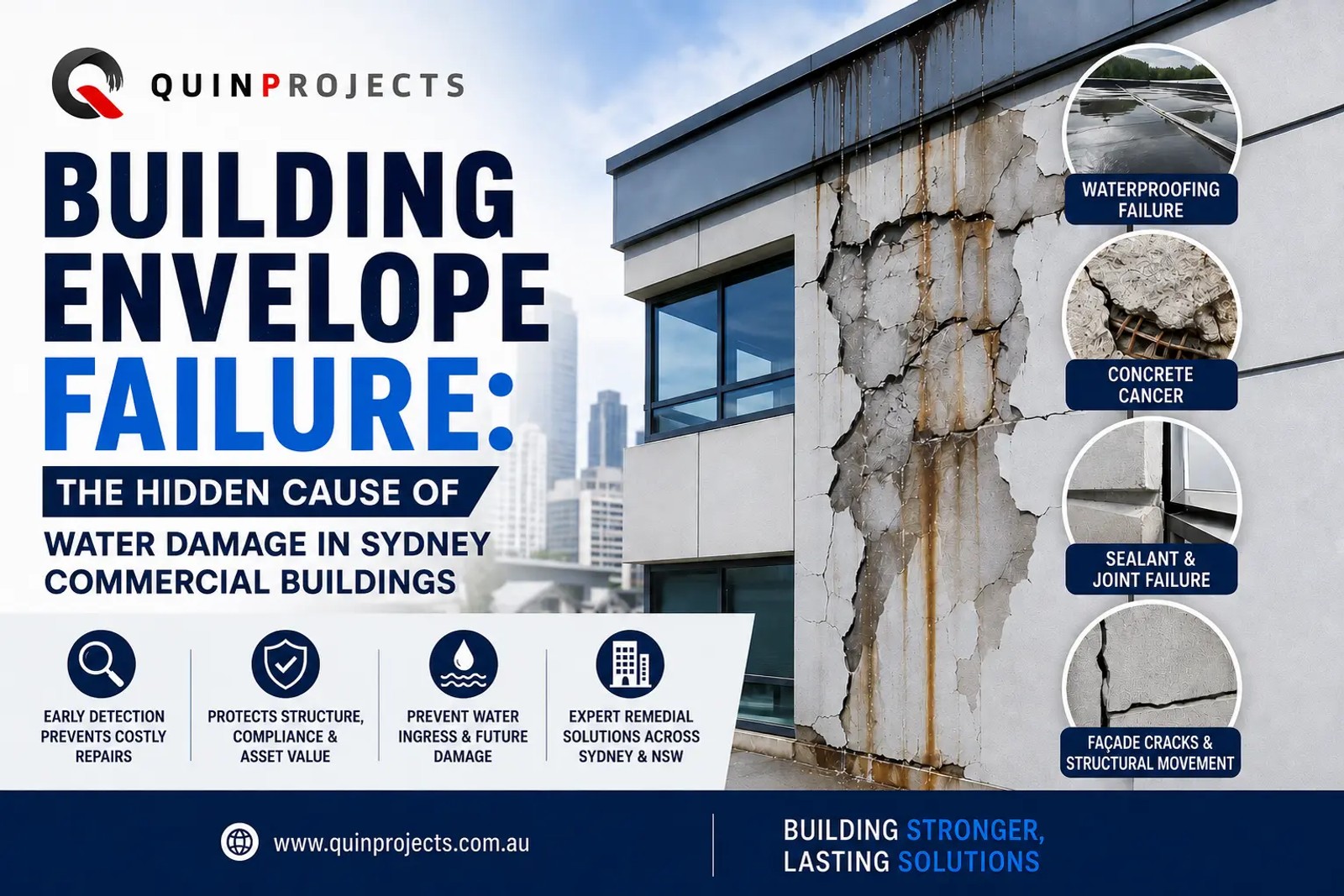

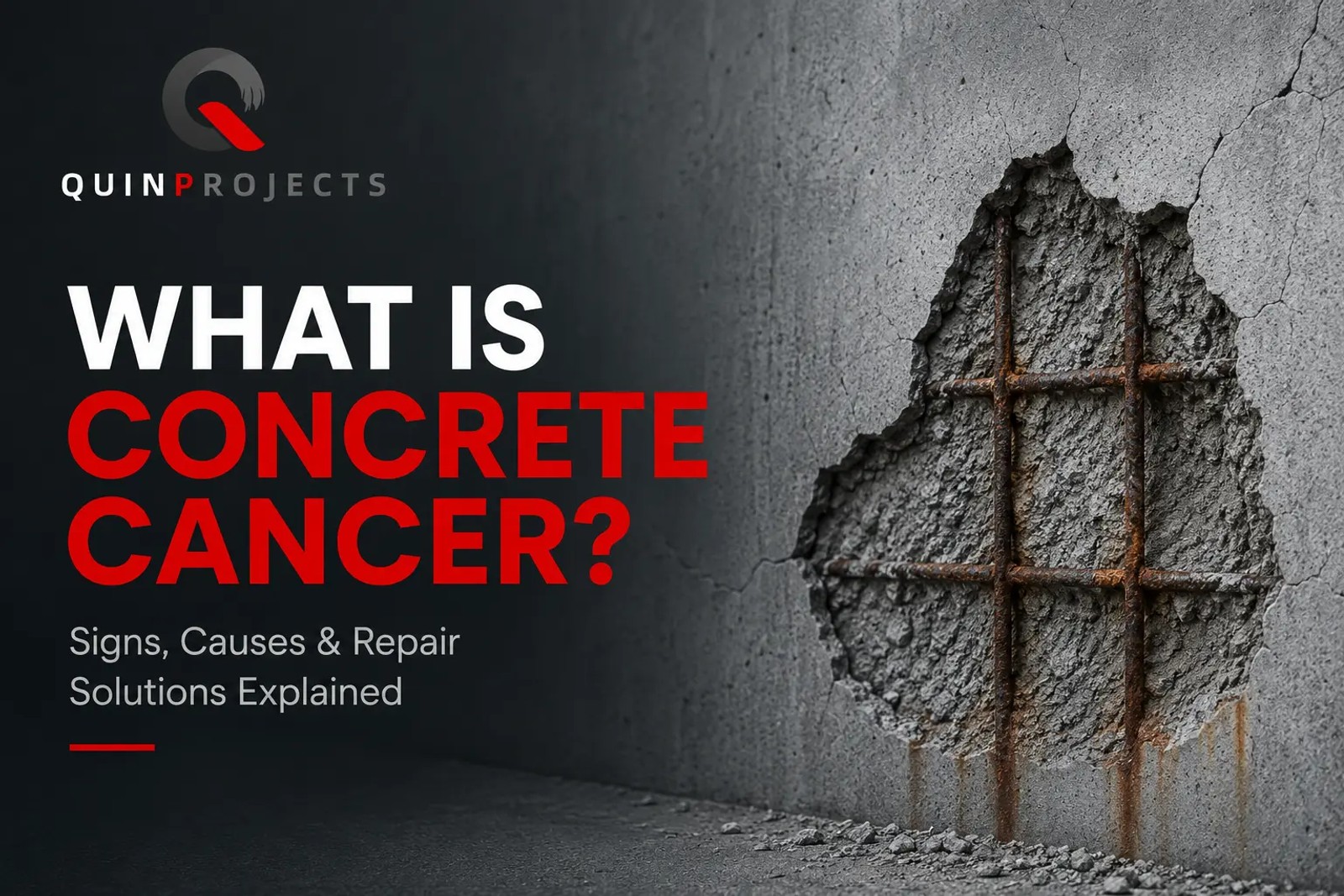
What Is Concrete Cancer? Signs, Causes & Repair Solutions Explained
What Is Concrete Cancer in Buildings, How It Starts Inside a Structure
Concrete is strong in compression but weak in tension. Steel rebar is embedded to handle tensile forces, making reinforced concrete the backbone of almost every modern building. When the steel is healthy, the surrounding concrete is structurally sound. When the steel corrodes, everything changes.
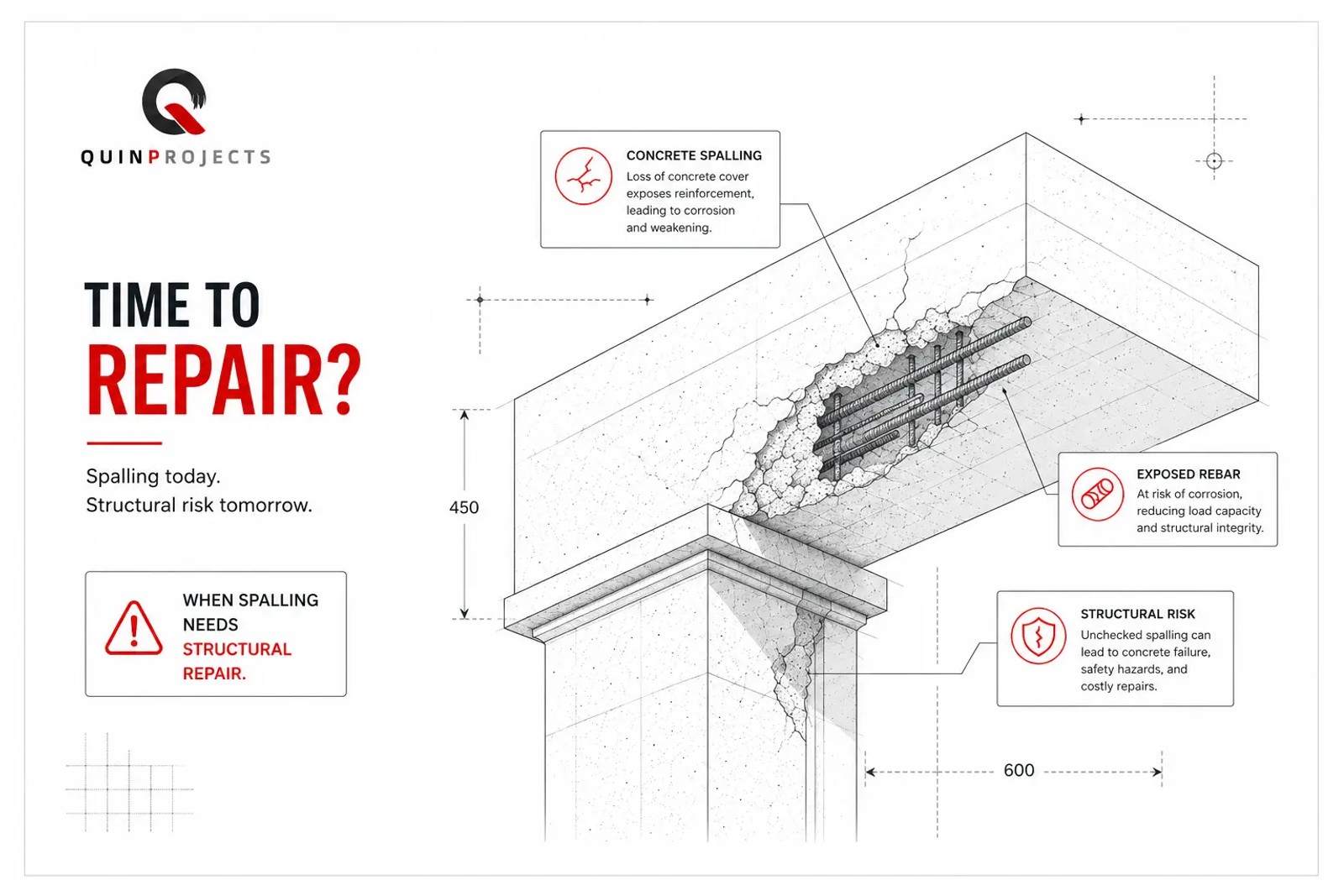
The core mechanism is straightforward but destructive. Rust products occupy substantially more volume than the original steel, generating internal pressure that the surrounding concrete simply cannot withstand. The result is a progressive sequence: cracking, then spalling, then structural compromise.
Two main pathways lead to rebar corrosion. The first is carbonation: carbon dioxide from the atmosphere diffuses into concrete, lowers the internal pH, and breaks down the passive film that normally protects steel from rusting.
The second is chloride-induced corrosion, which is particularly relevant in Sydney's coastal suburbs. Chloride ions from sea spray and salt-laden air penetrate through pores and cracks, crossing the corrosion threshold at the rebar and triggering localised pitting.
Poor concrete cover depth or a porous mix design accelerates both pathways significantly.
Under AS 3600, minimum cover requirements exist precisely because inadequate cover is one of the most common contributors to premature corrosion.
The "cancer" analogy holds for one specific reason: like a malignancy, this condition tends to grow outward from its origin point, spreading into surrounding healthy material as concrete spalling opens new pathways for moisture and oxygen.
Once damage reaches a certain stage, surface repairs alone are rarely sufficient to solve the problem.
Warning Signs to Look For at Each Stage of Deterioration
Early-stage concrete deterioration is easy to miss. Faint rust staining, hairline cracks running along rebar lines, slight bubbling or blistering under render, and early efflorescence (white salt deposits) rarely prompt immediate action. They look minor and often get painted over rather than properly investigated. That is a critical missed window.
As corrosion progresses, the signs become harder to ignore. Visible spalling, widening cracks, and patches where the concrete cover has separated into layers are the hallmarks of moderate damage.
This is the stage where the hollow-drum test becomes useful. If you tap concrete on balconies or soffits and hear a hollow, drumming sound combined with visible rust staining and surface loss, have it assessed professionally without delay.
Severe deterioration is unmistakable and urgent.
Exposed, rusting rebar, large missing sections of concrete, and warped or bulging surfaces indicate that rust expansion has pushed through the cover entirely.
At this stage, the structural capacity of the affected element has likely been reduced, and temporary shoring may be required before repairs can begin. This is no longer a maintenance issue, it is a structural safety matter requiring immediate specialist attention.
Why Concrete Cancer Gets Worse Fast If You Do Nothing
The damage cycle is self-reinforcing. Initial spalling exposes more steel to moisture and oxygen, which drives additional rust formation, which breaks away more concrete, advancing the corrosion front both laterally and deeper into the structure. Unlike a stable crack, active corrosion is a continuous chemical process.
Wetter periods increase moisture availability and typically accelerate that process, making Sydney's coastal climate a particularly demanding environment for ageing reinforced concrete.
The cost implications of delayed action are significant. A localised patch repair costing a few thousand dollars today can escalate into full structural member re-encasement costing tens of thousands if the damage is allowed to spread unchecked.
For strata buildings, the consequences extend beyond the repair bill. Owners corporations in NSW have a mandatory duty under Section 106 of the Strata Schemes Management Act 2015 to maintain and repair common property in a state of good and serviceable repair.
Allowing known deterioration to worsen creates direct liability exposure for the owners corporation, not just an escalating repair scope.
Sydney's coastal climate and the density of older reinforced concrete construction across the inner suburbs and Eastern Suburbs make concrete cancer a common challenge for the local building stock.
Older buildings constructed to earlier practices or with insufficient cover depth are more vulnerable, particularly in marine exposure zones, and should be checked against current AS 3600 requirements.
How to Diagnose Concrete Cancer in Buildings, and Why Your Contractor Choice Matters
The Professional Diagnostic Toolkit
A professional condition assessment draws on several established methods. Visual condition mapping and hammer sounding identify delaminated areas. Cover meter testing reveals whether the steel had adequate concrete protection in the first place.
Half-cell potential testing identifies zones of active corrosion even where spalling hasn't yet appeared. Readings more negative than -350 mV against a copper/copper sulfate reference electrode indicate greater than 90% probability of active corrosion, this matters because it allows a specialist to catch deterioration before it becomes visible.
Chloride content testing from core or powder samples quantifies salt contamination, and carbonation depth profiling using phenolphthalein indicator shows how far the pH drop has penetrated toward the steel. Together, these methods answer the three questions a proper investigation must resolve: what is failing, why it is failing, and how far it has spread.
For background on how chlorides and other mechanisms initiate rebar breakdown, see guidance explaining why rebar corrodes.
Why Unqualified Patch Repairs Fail
A general builder who patches visible spalling without conducting this diagnostic work is likely to seal over actively corroding rebar. Without addressing the underlying corrosion mechanism, such patches often fail in a relatively short time because corrosion continues behind the repair.
Misdiagnosis also leads to the wrong repair specification, applying a patch mortar incompatible with the host concrete, or failing to treat the rebar surface before re-encasing it. Neither outcome is acceptable when structural integrity is at stake.
Under the DBP Act 2020 in NSW, Class 2 building work carries registration requirements specifically because this type of structural concrete repair affects structural integrity.
Remedial builders registered under the DBP Act are authorised to provide compliance sign-off for Class 2 building work, confirm the specific requirements with the NSW regulator for your building type, and that sign-off protects the building owner if the work is ever scrutinised.
At Quin Projects, our Class 2 registration means every repair we carry out is backed by compliance documentation that unregistered contractors cannot provide.
What a Proper Condition Report Should Include
After a professional assessment, you should receive a written condition report covering the following.
First, a map of the extent of damage.
Second, identification of the likely corrosion mechanism, carbonation versus chloride-induced.
Third, a recommended repair method matched to the cause.
Fourth, a clear scope of work with a priority rating based on structural risk.
If someone hands you a quote without a written scope explaining the cause, that is a red flag worth heeding.
Concrete Cancer Repair Options and What They Typically Cost in Sydney
Patch Repair
Patch repair is the most common starting point for early to moderate damage.
The process involves breaking out deteriorated concrete beyond the corrosion front, cleaning and treating exposed rebar, applying a compatible repair mortar, and sealing the surface.
For small, localised areas, repair costs in Sydney typically range from a few hundred to a few thousand dollars. On a per-square-metre basis, current Sydney contractor rates for spalling repair sit broadly in the range of $100 to $150 per square metre, depending on access and the number of affected areas.
Re-encasement and Cathodic Protection
When corrosion is widespread across a structural member or multiple members, re-encasement becomes necessary. This involves forming new concrete around the treated element and is a more invasive process, typically moving into the $150 to $300 per square metre range and above, with complex access and significant steel section loss pushing costs higher.
Preventing corrosion in reinforced concrete measures, including improved concrete cover, low-permeability mixes, and protective systems such as cathodic protection, are typically considered alongside re-encasement where long-term performance is required.
These system-based solutions typically suit larger or mid- to high-rise buildings where repeated facade access would otherwise drive up long-term maintenance costs.
Access and Site Costs
Access is typically the dominant cost variable on Sydney properties. Low-rise residential repairs are significantly cheaper than mid- and high-rise work because scaffold, elevated work platform hire, and site management costs scale with height.
Concrete cancer repairs in strata buildings almost always require staging to minimise disruption to residents, which adds coordination time and cost to the overall program.
A 5-Step Action Plan for Building Owners and Strata Managers
Step 1: Document what you can see.
Walk the perimeter and photograph any visible rust staining, surface cracking, spalling, or bubbling. Note which elements are affected: balcony soffits, slab edges, columns, retaining walls, or car park ceilings. This documentation gives your specialist a starting reference and helps establish when the issue was first noticed, relevant for both insurance disclosure and any warranty claims.
Step 2: Tap-test suspect areas and mark hollow patches.
Use a hammer or the back of a screwdriver to tap across affected surfaces. Hollow or drumming sounds indicate delamination. Mark these areas with chalk or tape. This is not a substitute for professional assessment, but it gives you a rough picture of how widespread the problem is before you call anyone.
Step 3: Commission a specialist inspection.
Engage a licensed remedial building consultant or a registered Class 2 Building Practitioner to conduct a formal condition assessment. For strata buildings, the owners corporation should minute the decision and retain the report as part of the building's maintenance records.
Step 4: Review the report against clear criteria.
Has the cause been identified? Is the scope of works specific and clear? Is there a priority rating based on structural risk? If the report recommends further structural engineering review, arrange it before proceeding with repairs. A report that only lists what needs patching without explaining why the damage occurred is incomplete.
Step 5: Select a qualified contractor and act on the scope.
Look for a remedial builder registered under the DBP Act 2020 for Class 2 work, with demonstrated experience in structural concrete repair. Quin Projects operates throughout Sydney's Eastern Suburbs and carries Class 2 Building Practitioner registration under the DBP Act 2020, conducting concrete cancer assessments and carrying repairs through to compliance sign-off.
Acting on the scope within a defined timeframe, rather than deferring, is the single most effective way to keep the repair cost manageable and the building safe.
Managing Concrete Cancer for Long-Term Structural Integrity
Concrete cancer is not a cosmetic issue and it does not stabilise on its own. The mechanism is a continuous chemical process, one that accelerates once the concrete cover is compromised. The good news is that it is diagnosable and repairable at every stage, and the earlier it is caught, the more straightforward and cost-effective the solution.
For strata managers and owners corporations, acting promptly also fulfils the legal obligation to maintain common property under the Strata Schemes Management Act 2015 and protects the building's long-term asset value. Waiting until damage is severe trades a manageable repair scope for a major remediation project, often at several times the original cost.
If you've spotted any of the warning signs described here, understanding what is concrete cancer in the buildings is only the first step, the next is a professional assessment by a licensed remedial specialist with the diagnostic tools and regulatory standing to give you a reliable answer.
A correct diagnosis, a qualified contractor, and prompt action convert a serious maintenance problem into a resolved one.